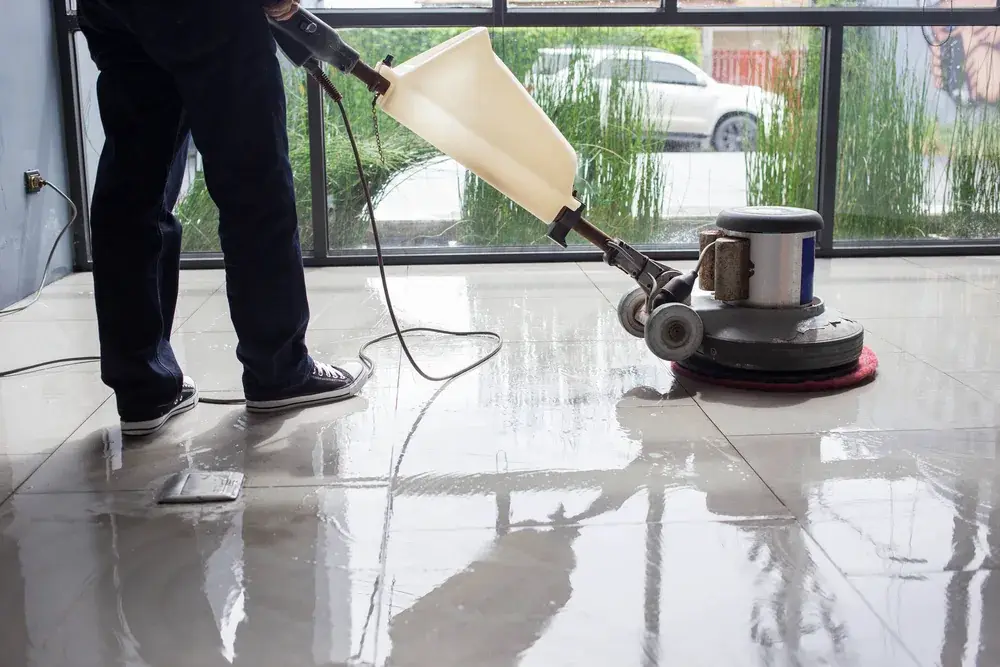
When people say "I want my marble ground down," they often mean two different things. Grinding and polishing are distinct stages of one process, and understanding the difference helps you order the work correctly and set the right expectations for the result.
Grinding: building the foundation
Grinding is the removal of the stone's top layer with coarse diamond discs to eliminate scratches, unevenness and old damage, resulting in a flat but still matte surface.
This is the stage where the real problems get solved: deep scratches, height differences between tiles (known as "lippage"), acid etching. Without proper grinding, polishing simply makes an uneven surface shiny, which emphasises the flaws rather than hiding them.
Polishing: creating the shine
Polishing follows grinding and is carried out with progressively finer discs and polishing compounds, until the stone surface becomes so smooth that it starts reflecting light like a mirror.
An important point: the shine is not an applied coating but the physical state of the stone surface itself. That's why correctly polished marble holds its shine for years, unlike wax or lacquer coatings that wear away.
What result do you want: honed or polished?
- Honed (matte) surface: we stop after the grinding stage at a medium grit. The result is flat, pleasant to the touch and not slippery. Suitable for staircases, bathroom floors and high-traffic zones, since scratches and acid marks are far less noticeable.
- Polished (glossy) surface: we run the full sequence through to the finest stage. The result is a mirror shine that brings out the beauty of the stone's veining. Suitable for living rooms, hallways and representative spaces.
When polishing alone is enough
If the floor is structurally in good condition — without deep scratches or unevenness — and has simply lost its shine to everyday wear, it's possible to limit the work to the finishing polishing stages. This is faster and more affordable than a full grind-and-polish cycle.
When a full grind is necessary
The full cycle is needed when there are deep scratches, acid etching, height differences between tiles, or when the floor has never been treated since installation. As we explain in our article on the signs a floor needs polishing, in these cases polishing alone won't deliver the desired result.
Why this matters when comparing quotes
When comparing quotes, always ask whether grinding is included or whether it's polishing only. A significantly lower price often means only surface polishing is being offered, which will give a beautiful result only on a floor that's already in good shape. Our price guide explains the pricing in detail.
Not sure what your floor needs? Send a photo or book a free inspection: we'll assess the condition and tell you whether polishing suffices or a full grind is required. See our polishing service or contact us.