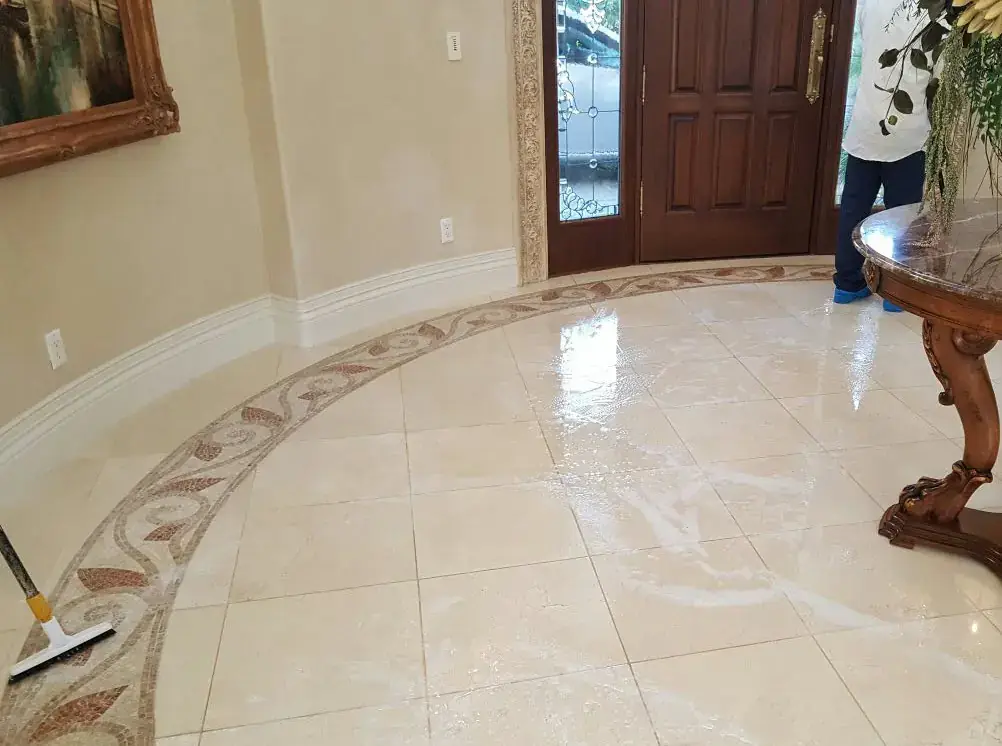
Travertine is a warm, natural-looking stone, but it is polished and restored differently from marble. Its natural holes, calcareous make-up and sensitivity to acids call for separate steps: filling, staged grinding and polishing, and always sealing. This guide explains how travertine polishing and restoration work, and what you can do yourself.
Why travertine behaves differently from marble
Travertine is a sedimentary limestone that forms around mineral springs, which is why it contains natural voids and pores, and why it is just as sensitive to acids as marble.
In hardness travertine is close to marble (around 3-4 on the Mohs scale), so scratches and wear grind out well. The main difference is the holes: grinding also opens voids hidden just below the surface, and those have to be filled again. If you are still choosing a stone, see marble vs travertine.
Typical travertine damage
- Open holes. Over time the fill cracks or pops out, and dirt and water collect in the open pores.
- Dull traffic paths. In walkways, at entrances and on stairs, sand and shoes wear the finish away.
- Etch marks. Lemon, vinegar, wine or acidic cleaners leave dull, light-coloured marks.
- Dark pores and stains. Without a sealer, travertine soaks up oil, coffee and dirty mop water.
Filling the holes: when and with what
On indoor floors and countertops, travertine holes are usually filled so the surface is smooth, doesn't trap dirt and is easy to clean. Fillers are cement-based or resin-based (epoxy or polyester) and tinted to match the stone.
- Colour-matched fill. The filler is matched to the stone's tone, so the holes almost disappear. This is the most common choice.
- Contrasting fill. A darker or lighter filler that emphasises the stone's natural structure. A matter of taste, but later repairs are more visible.
- Unfilled travertine. On outdoor terraces and around pools the holes are sometimes left open on purpose, for a more natural look and better grip.
The order matters: the filler must cure fully before grinding, and after the first grinding pass a second fill is often needed, because grinding opens new voids.
Grinding and polishing: honed or polished travertine
Travertine is ground with diamond discs and water, working from coarse to fine grit, and the process stops at the stage that gives the finish you want: honed (matte) or polished.
- Honed. A smooth, satin surface without a mirror shine. It is less slippery and hides wear and etch marks better, so it suits stairs, bathrooms and wet areas.
- Polished. A deep shine that brings out the pattern of the stone. It suits living rooms and hallways, but is more slippery when wet and shows etch marks more.
Light etching and surface dullness often disappear in the final polishing stages alone, while deep scratches and worn paths need full grinding. For the difference between those steps, read grinding vs polishing; for stains, see how to remove stains from marble. The same rules apply to travertine.
Sealing and daily care
After grinding, travertine is always sealed: grinding reopens the pores, and without protection the stone quickly absorbs liquids. The impregnating sealer goes onto clean, fully dry stone and is checked with the water drop test: if the drop doesn't soak in, the protection works.
- Clean with lukewarm water and a pH-neutral stone cleaner.
- Avoid vinegar, lemon and acidic limescale removers: they dissolve limestone.
- Put a mat at the entrance so sand doesn't scratch the surface.
- Wipe up spills straight away, especially wine, coffee and oil.
The sealer needs renewing periodically, usually every 2-3 years depending on use. More on our stone maintenance service page.
DIY or professional?
Cleaning, renewing the sealer and patching a few isolated small holes with a travertine repair filler are realistic DIY jobs; grinding and polishing a whole floor is not.
Without a floor machine and the right sequence of discs, the result is usually uneven: waves, patchy gloss and newly opened holes. We cover the same reasoning in DIY vs professional marble polishing. If tiles are cracked or broken, you are looking at stone renovation.
We fill the holes, grind and polish travertine with diamond discs to a honed or polished finish, and seal the stone at the end. See our travertine polishing in Yerevan, or book a free inspection and we'll tell you what your floor actually needs.