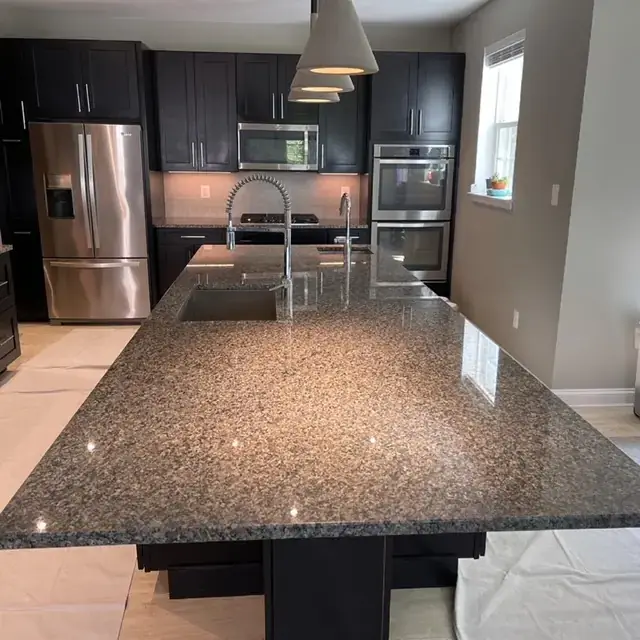
Granite is one of the hardest natural stones, and that is exactly why polishing granite yourself works differently from polishing marble. Part of the job really can be done by hand: bringing back shine that is hidden under residue, refreshing a slightly dull countertop, renewing the protection. Scratches, worn traffic paths on a floor and chipped edges, however, call for diamond tooling and experience. Here is where that line runs.
Why granite is polished differently from marble
Granite rates 6-7 on the Mohs scale against 3-4 for marble, so the paste and cloth that refresh marble remove almost nothing from granite: real granite shine only comes back with diamond abrasives.
There is good news too: granite is a silicate stone and doesn't react to acids the way marble and travertine do. The dull etch marks from lemon or vinegar that are typical on marble are rare on granite. So dull granite usually means one of three things: residue on the surface, a worn-out protective sealer, or genuine wear of the stone. For more on the differences, see marble vs granite.
Diagnose first: residue, sealer or wear?
Before polishing anything, wash the area with a pH-neutral stone cleaner and dry it: if the shine comes back, it was residue, not wear.
- Residue. Limescale from hard water and leftovers of cleaners containing wax or "shine" agents form a cloudy film. It comes off with cleaning; the stone itself doesn't need polishing.
- Worn sealer. Put a drop of water on the surface: if it soaks in and the stone darkens, the protection is gone. The stone may look duller and soil faster, but the surface is still intact.
- Worn stone. Dull paths in walkways, scratches your fingernail catches on, chips on a countertop edge: this is damage to the surface itself. Only grinding and polishing with diamond discs will fix it.
What you can do yourself
- Deep clean. A pH-neutral stone cleaner, a soft brush, a thorough rinse. Avoid abrasive powders and scouring pads: they leave micro-scratches on a polished surface.
- Remove limescale. Use a product made for natural stone and test it on an inconspicuous spot first: some stones sold as "granite" actually contain calcite or have a resin fill that is sensitive to acid.
- Granite polishing powder or paste. On a slightly dull area of a countertop, work it in by hand with a felt pad or soft cloth in small circular motions. It refreshes the shine but won't remove scratches.
- Seal. Once the stone is clean and fully dry, apply a natural stone impregnating sealer following the manufacturer's instructions, and wipe off the excess before it dries on the surface. It adds no shine, but protects the stone against oil and stains.
Polishing granite by hand with diamond pads: worth trying?
Flexible diamond polishing pads on an angle grinder with water let you polish a small area or a countertop edge, but on floors and larger surfaces the result almost always turns out uneven.
The principle is the same as professional polishing: a sequence of pads from coarse to fine grit (for example 50, 100, 200, 400, 800, 1500, 3000), each one removing the marks of the previous one. You can't skip steps: scratches from a coarse pad will stay visible under the shine. On hard granite, each stage takes noticeably longer than on marble.
The main risks: waves and patchy gloss from uneven pressure, overheating the stone when working without water, burn marks on dark granite and a damaged edge profile. And an important health point: dry grinding granite produces dust containing crystalline silica. Only work wet and with a respirator, and never dry-grind indoors in a home.
What not to do with granite
- Wax, oil and furniture polish: shiny for a few days, then they leave a sticky film that collects dirt.
- Abrasive powders and steel wool: leave a web of fine scratches.
- Harsh chemicals (bleach, strong alkalis): break down the protective sealer.
- An angle grinder at full speed without speed control: the quickest route to burn marks and unevenness.
When to call a professional
If your granite has scratches you can feel with a fingernail, worn paths on a floor, chips or height differences between slabs, DIY polishing won't give an even result: it needs staged grinding with professional equipment.
We grind and polish granite floors, stairs and countertops with water-cooled machines and dust extraction, so the work is dust-free. For the difference between grinding and polishing, read grinding vs polishing; for costs, see our price guide. If it's marble rather than granite, see DIY vs professional marble polishing, and for local stone, Armenian granite.
Not sure what your granite needs? Send a photo or book a free inspection: we'll tell you whether cleaning and sealing will do or polishing is needed. More on our stone polishing and countertop polishing pages.