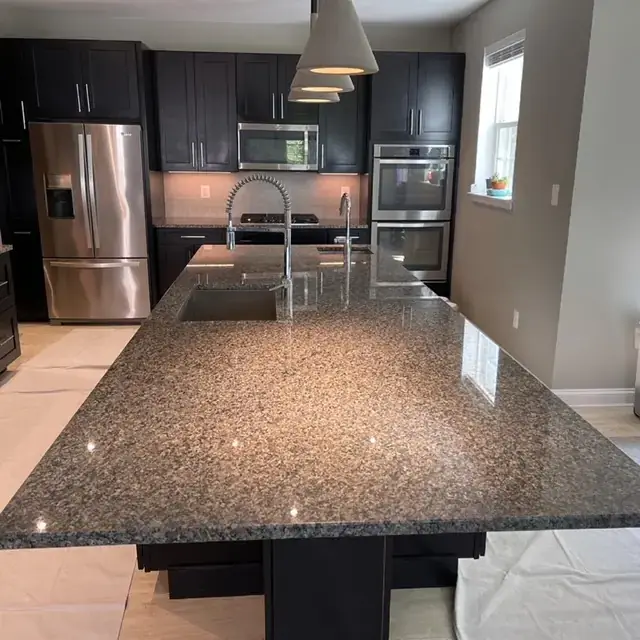
When people talk about Armenian stone, tuff is the first thing that comes to mind. But Armenia's bedrock is also rich in granite, and local granite is a competitive alternative to imported stone on both price and quality. This article covers Armenian granite: what types exist, how they differ, and how to care for them properly.
What granite is and why it's so durable
Granite is an igneous rock formed by magma cooling slowly deep in the earth's crust, producing a dense crystalline structure of quartz, feldspar and mica grains.
That slow cooling is exactly what gives granite its characteristic grainy appearance and exceptional hardness: 6-7 on the Mohs scale. For comparison, marble sits at 3-4. Granite is also silicate rather than calcareous, which means it doesn't react to acids, unlike marble and travertine.
What sets Armenian granite apart
Armenia's granite deposits are concentrated mainly in the Syunik and Lori regions. Local granite stands out in several ways:
- Colour range: from grey through to pink and reddish tones, often in a warmer register than the classic Scandinavian grey granite.
- Grain size: many local varieties have a medium to coarse grain, which produces an expressive, deep pattern once polished.
- Frost resistance: stone formed in Armenia's climate is naturally adapted to sharp temperature swings, an advantage for outdoor use.
- Sensible pricing: the absence of long-distance transport often makes local granite more affordable than an imported equivalent of the same quality.
Armenian or imported granite?
Imported granite (India, Brazil, China) offers a wider colour selection, especially the more exotic patterns. Arguing for local stone: price, availability, and the fact that you can see the exact slab you're buying rather than ordering from a catalogue.
Technically, good Armenian granite is in no way inferior to imported stone: hardness, water absorption and durability are determined by the specific quarry, not the country. We recommend asking for the quarry's technical datasheet with the water absorption figure (below 0.5% for good granite).
Where granite is the best choice
- Kitchen countertops: its acid resistance and hardness make granite the classic choice. See our countertop service.
- Entrances and staircases: in high-traffic areas, granite's wear resistance is hard to beat.
- Outdoor surfaces: frost and water resistant, suitable for terraces and facades.
- Offices and public buildings: where daily load is heavy.
Caring for granite: simpler, but not optional
Granite is acid resistant, so it doesn't get the etching that marble suffers from, but it is porous and without sealing it can absorb oil and staining liquids.
For daily care, a pH-neutral cleaner and a soft cloth are enough. Repeat sealing every 2-3 years, especially on kitchen countertops. The water drop test is the simplest check: if water still beads up, the protection is working.
A common mistake is to assume granite is "indestructible" and needs no care. In reality, lost shine and oil stains are just as common on granite as on marble; they simply develop more slowly. For a detailed comparison, see marble vs granite.
Polishing granite: how it differs from marble
Granite's hardness means polishing takes longer and requires coarser diamond discs in the early stages. In return the result lasts longer: a granite floor holds its shine for years after polishing.
If you're unsure whether your floor needs a full grind or just polishing, see grinding vs polishing, and for the cost of the work, our price guide.
Do you have an Armenian or imported granite floor, countertop or staircase that needs care or polishing? See our polishing service or contact us for a free inspection anywhere in Armenia.