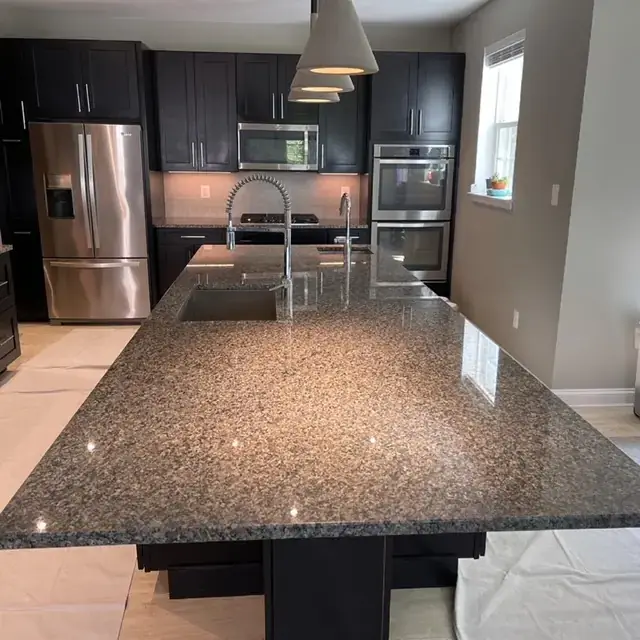
A kitchen countertop is one of the most active surfaces in the home: knives, pots, metal utensils, every day. Over time, small scratches accumulate, and the question arises: can I fix them myself, or do I need a professional? The answer depends on the stone type and the depth of the scratch.
Scratches on granite countertops
Granite is an extremely hard stone (6-7 on the Mohs scale), meaning real scratches are rare and usually mean the object that scratched it was diamond or another extremely hard material. What many people call a "scratch" on granite is often actually a dull spot or wear on the mineral binding resin, not a true scratch in the stone.
DIY fix for surface shine loss: granite polishing powder and a soft tool can restore shine in cases of surface wear. A genuinely deep scratch requires professional polishing.
Scratches on marble countertops
Marble is much softer (3-4 on the Mohs scale), so scratches happen much more often and more easily — even from an ordinary kitchen knife or ceramic dishware. Surface scratches on marble countertops can often be softened with a marble polishing paste, but genuinely deep scratches almost always require professional polishing, since hand polishing rarely achieves a mirror-flat result.
DIY repair steps (surface scratches only)
- Clean the surface with a pH-neutral cleaner and let it dry completely.
- Apply a polishing paste made for stone (not a general metal polish) with soft microfiber, using small circular motions.
- Work in small sections, regularly checking the result in light from different angles.
- Finish with hydrophobic sealing if the restored area has lost its protective layer.
When professional polishing is required
If your fingernail "catches" on the edge of the scratch (you can physically feel it), if the scratch is visible from different angles with the same intensity, or if home methods haven't worked after a few attempts, the damage has reached the stone's structure. In this case, professional polishing (with diamond discs, in progressively finer grits) is the only way to get a genuinely flat, mirror-like surface. DIY attempts with the wrong tool can even make things worse by creating new, larger scratches.
See also how to remove stains from marble, or go straight to our countertop polishing service for deep scratches. Contact us for a free assessment.