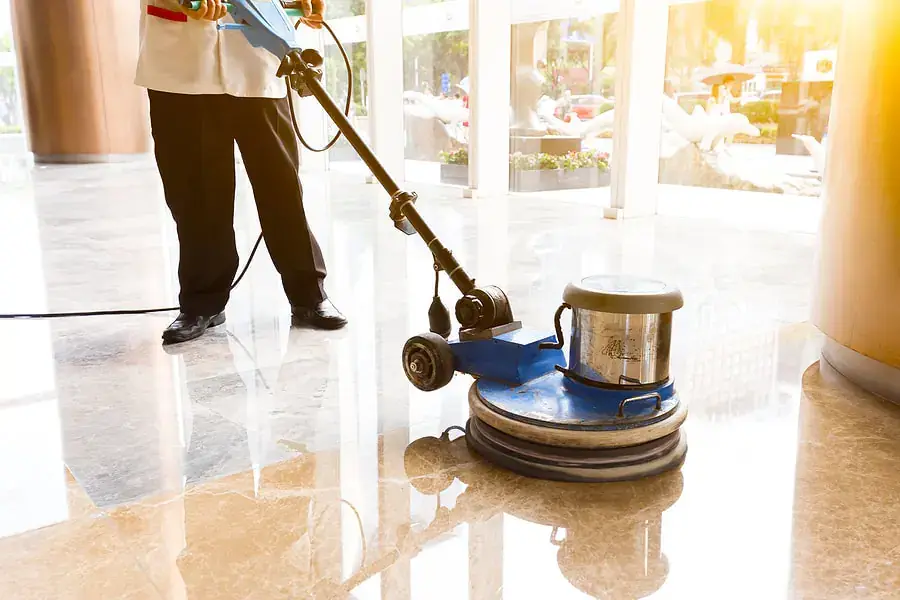
"Marble polishing" can mean very different techniques depending on who you ask. One method restores the surface of the stone itself, another creates a glossy layer through a chemical reaction, and a third simply puts a coating on top. This guide explains the main types of marble polishing, so you can compare quotes properly and know what your floor actually needs.
In short: four approaches
Only diamond grinding and polishing removes scratches, etch marks and uneven tile edges; crystallization, powders and wax only work on the shine of the surface.
| Method | What happens | Removes scratches? |
|---|---|---|
| Diamond grinding and polishing | The top micro-layer of the stone is removed with diamond discs, from coarse to fine | Yes |
| Crystallization | A special product reacts with calcareous stone and forms a hard, glossy surface layer | No |
| Polishing powders and compounds | Refresh the shine of a slightly dull surface, by hand or by machine | No |
| Wax, lacquer, "shine" products | Leave a coating on the stone that wears away over time | No |
Diamond grinding and polishing
Diamond polishing is a mechanical method: a floor machine works through diamond discs from coarse to the finest grit, removing the damaged top micro-layer of the stone until the surface is flat and starts to reflect light.
Here the shine is not an applied layer but the state of the stone surface itself, which is why it lasts. The coarse stages remove scratches, etch marks and height differences between tiles; the fine stages bring the shine. You can also stop at a honed (matte) finish. The stages are explained in grinding vs polishing.
Wet polishing is the standard: water cools the discs and binds the dust. Dry polishing is sometimes used for the final stages or where water can't be used, but it creates more dust and a risk of overheating the stone.
Marble crystallization
In crystallization, a special chemical product is worked into the surface with a floor machine and steel wool; it reacts with the calcium carbonate in the stone and forms a thin, hard, glossy layer.
It produces a shine quickly, and it is sometimes used in commercial spaces to maintain the gloss of a floor that has already been polished. But it has limits:
- It doesn't remove scratches. Crystallization puts a shine on the surface as it is, damage included.
- Calcareous stone only: marble, travertine, limestone. The reaction doesn't work on granite or basalt.
- It needs correct application. Mistakes leave patchy gloss and a film that later has to be ground off.
Polishing powders and compounds
Marble polishing powders and compounds are worked in with a felt pad, by hand or with a slow-speed machine, and refresh the shine of a slightly dull surface. They work well on small areas such as a countertop, and on light etch marks.
A powder won't remove deep scratches or worn traffic paths: that takes staged grinding. What you can realistically do yourself, and when to call a professional, is covered in DIY vs professional marble polishing; for stains, see how to remove stains from marble.
Wax and lacquer: why they are not polishing
Wax, lacquer and products "with shine" don't polish the stone: they leave a coating on the surface that shines until it wears off.
Traffic marks show quickly, the coating can yellow and hold dirt, and it has to be stripped completely before real polishing. For daily care, a pH-neutral cleaner without wax is the better choice; see our marble floor maintenance schedule.
Which method does your marble need?
- Scratches, etch marks, uneven tiles: diamond grinding and polishing, with a sealer at the end.
- The floor is just dull, without deep damage: the final polishing stages are often enough.
- A small dull area on a countertop: a polishing powder or compound.
- Granite or basalt: diamond work only; see how to polish granite.
- Travertine: fill the holes first, then grind; see travertine polishing and restoration.
When comparing quotes, ask exactly which method is included: it explains large price differences. More in our price guide.
How we work
We polish marble with diamond discs and professional compounds, and finish with a protective sealer. See our marble polishing service, our work in Yerevan and our stone maintenance, or book a free inspection and we'll tell you what your floor actually needs.